


 Written and medically reviewed byDr. Naina BaidyaGeneral Dentist · Updated
What Is a Cavity in a Tooth?
A cavity is a hole in a tooth caused by decay. The National Institute of Dental and Craniofacial Research on tooth decay explains it this way: “Tooth decay begins when bacteria in your mouth make acids that attack the tooth’s surface (enamel). This can lead to a small hole in a tooth, called a cavity.”
The Ontario Dental Association on cavities and tooth decay puts it even more simply: “Cavities (or caries) are little holes that form in the enamel.” Enamel is hard, but it can’t grow back once it’s gone. That’s why a cavity doesn’t close up on its own after it has formed.
What Causes Cavities in Teeth?
Cavities start with plaque, the sticky film that builds up on your teeth every day. According to the ODA, the bacteria in plaque “feed on the sugars and starches left behind after meals and produce acids that attack tooth enamel.”
Each time you eat or drink something sugary, those acids go to work. A few things make cavities more likely:
- Sipping sweet drinks or snacking often through the day
- Skipping brushing or flossing, so plaque stays on longer
- Not using fluoride toothpaste
- A dry mouth, since saliva helps wash away food and acid
- Deep grooves on back teeth, or gaps around old fillings, where food gets trapped
Early Signs of a Cavity
The hard part is that early decay is usually quiet. The NIDCR notes that “in early tooth decay, there are not usually any symptoms.” The first visible sign is often a chalky white spot on the enamel, where minerals have been lost.
As decay goes deeper, you may notice:
- Sensitivity when you eat or drink something sweet, hot or cold
- A toothache, or pain when you bite down
- A brown, grey or black spot on the tooth
- A small hole or rough patch you can feel with your tongue
- Food that keeps catching in the same spot
Most cavities are found at regular checkups before you feel anything. Your dentist looks for soft spots on the enamel and uses X-rays to see between teeth, where you can’t look yourself.
The Stages of Tooth Decay
Decay moves from the outside of the tooth inward. The earlier it’s caught, the smaller the fix.
| Stage | What happens | Signs you might notice | Usual treatment |
|---|---|---|---|
| 1. Early decay (white spot) | Acid pulls minerals out of the enamel | Usually none; maybe a chalky white spot | Fluoride, better brushing, fewer sugary snacks |
| 2. Enamel breaks down | The weakened enamel gives way and a small hole forms | Often none; sometimes a dark spot | A small filling |
| 3. Decay reaches the dentin | Decay spreads into the softer layer under the enamel | Sensitivity to sweets, hot or cold | A larger filling |
| 4. Decay reaches the pulp | Bacteria reach the nerve and blood supply inside the tooth | Toothache, pain when biting, lingering pain | Root canal treatment, often with a crown |
| 5. Infection or abscess | Infection spreads to the root tip and nearby tissue | Swelling, throbbing pain, a bad taste | Root canal or removing the tooth |
The NIDCR describes the turning point between stages 1 and 2: “If more minerals are lost than can be restored, the enamel weakens and eventually breaks down, forming a cavity.”
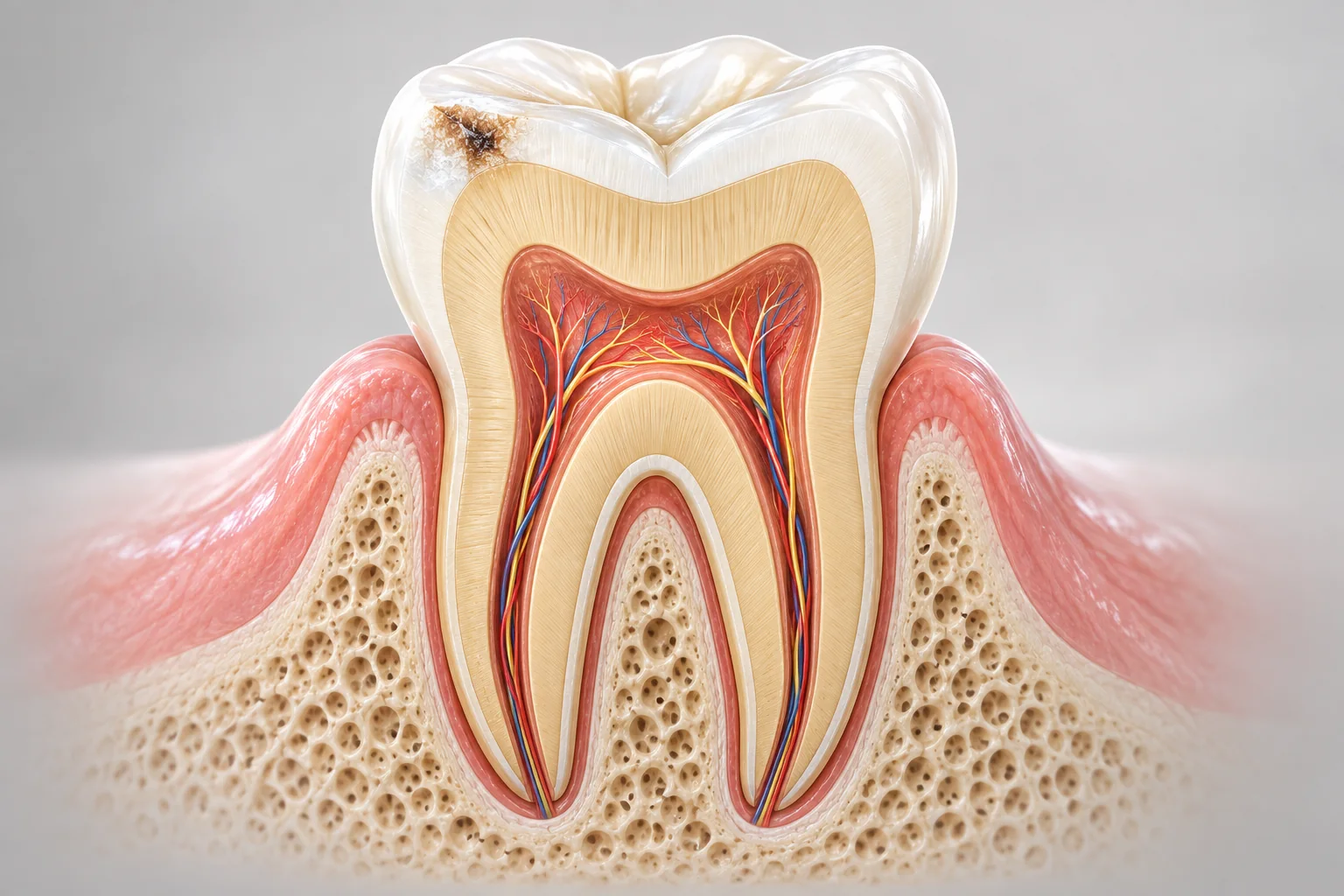
How a Tooth Cavity Is Treated at Each Stage
Before a hole forms. This is the one stage you can turn around. The NIDCR says “tooth decay can be stopped or reversed at this point,” because enamel can repair itself with minerals from saliva and fluoride from toothpaste. “If tooth decay is still in its early stages, before a hole (cavity) forms, the dentist can apply fluoride to reverse the decay.”
A small or medium cavity. Once there’s a hole, it needs a filling. The Canadian Dental Association on fillings notes that your dentist “may keep an eye on it (if it’s small) or fill it right away.” Our tooth-coloured fillings are usually done in one short visit:
- The area is numbed.
- The decayed part of the tooth is removed.
- The space is filled with tooth-coloured material and hardened with a light.
- The filling is shaped and polished, and your bite is checked.
A filling usually takes 20 to 60 minutes. Your lip or cheek may stay numb for 2 to 3 hours, and the tooth can be a little sensitive to cold for a few days.
A deep cavity. The Cleveland Clinic’s guide to dental fillings is clear on this: “If a cavity grows so large that it reaches the pulp of your tooth, a dental filling won’t fix the issue.” At that point, root canal treatment removes the infected pulp so the tooth can be kept. A back tooth that has lost a lot of structure often needs a crown afterwards to protect it from cracking.
What Happens If You Leave a Cavity Untreated?
A cavity won’t stay the same size. The ODA warns that “if left untreated, a cavity will grow, and eventually, bacteria can get into the soft tissue of the inner tooth. That can lead to pain, infection and more serious treatment, such as a root canal.”
How fast that happens varies from person to person and tooth to tooth, so there’s no safe waiting period. What’s predictable is the direction: waiting usually means a bigger filling, or a root canal and crown later. The CDA adds that with a large cavity, “the tooth may even have to be removed and replaced with a false (or artificial) tooth.”
How to Prevent Cavities
Most cavities can be prevented with daily habits and regular care. The NIDCR and the ODA both recommend:
- Brushing at least twice a day with fluoride toothpaste
- Flossing every day to clear plaque between teeth
- Limiting sugary foods and drinks, especially between meals
- Drinking water through the day
- Avoiding tobacco
- Seeing your dentist regularly for checkups and cleanings
Children get cavities too, and baby teeth matter. Our dentist for kids can check your child’s teeth and talk about fluoride and sealants for the grooves on back teeth. For more detail, read our guide on how to prevent cavities.
When to See a Dentist About a Tooth Cavity
Book a visit if you notice a new spot on a tooth, sensitivity that keeps coming back, or food catching in the same place. Don’t wait for pain. By the time a cavity hurts, it’s often deep.
Call sooner if you have a toothache that keeps you up, swelling in your face or gums, or a bad taste that won’t go away. These can be signs of infection. See our emergency dental care page for same-day help. River Run Dental Centre is open 7 days a week, including evenings and Sundays.
Cavity In A Tooth: Frequently Asked Questions
Can a cavity heal on its own?
Early decay can. Before a hole forms, fluoride and minerals from saliva can repair weakened enamel, so a white spot may stop or reverse. Once enamel has broken down into an actual hole, it can’t grow back, and the cavity needs a filling.
Do cavities always hurt?
No. Early decay usually causes no symptoms at all, which is why cavities are so often found at checkups. Pain or sensitivity tends to show up once decay has reached deeper layers of the tooth.
How long can a cavity go untreated?
There’s no set timeline. Some cavities grow slowly and some grow quickly, depending on the tooth, your diet and your habits. Your dentist may watch a very small one, but a cavity that’s already formed won’t go away, and the longer it’s left, the bigger the repair tends to be.
Can you see a cavity yourself?
Sometimes. You might spot a white, brown or dark area, or feel a rough patch with your tongue. Many cavities start between teeth or under old fillings, though, where only a dental exam and X-rays can find them.
Are cavity fillings covered by insurance or CDCP?
Many dental plans cover part of the cost of fillings, but the amount depends on your plan. We direct bill insurance so you only pay your share, and we also accept the Canadian Dental Care Plan (CDCP).
Ready to talk about your smile?
Book a consultation at River Run Dental Centre in Mississauga. We’ll check your teeth, explain your options and costs, and bill your insurance directly. Open 7 days, including evenings and Sundays.
Related Articles
- How to Prevent Cavities: 8 Habits That Protect Your Teeth
- Root Canal Treatment: Signs You Need One, What Happens and Recovery