


 Written and medically reviewed byDr. Karishma Phutela (Dr. Tina)General Dentist · Updated
What Are Veneer Teeth?
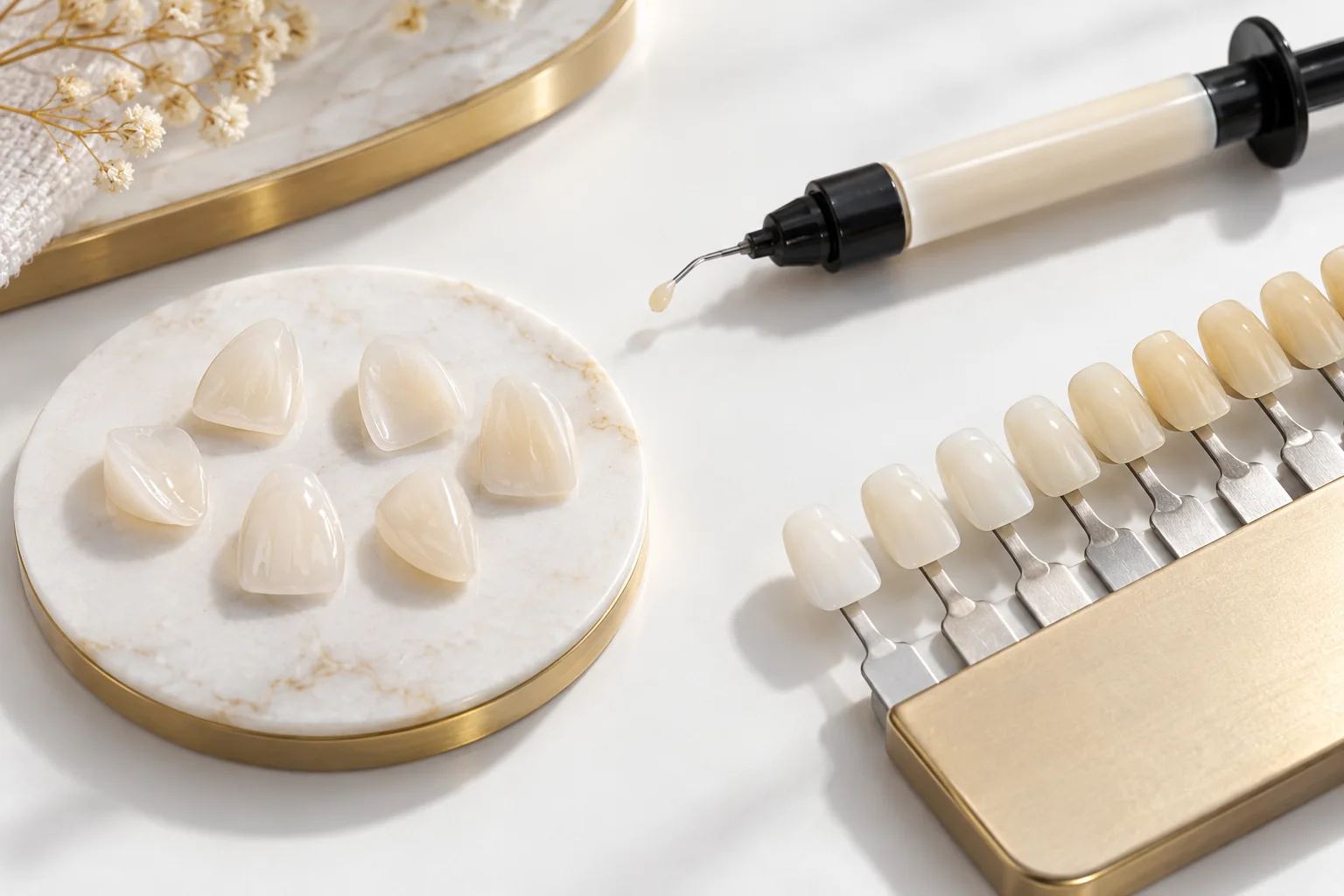
Veneer teeth are your own teeth with a thin custom shell bonded to the front surface. The shell covers what you don’t like, such as a stain, a chip or an uneven edge, while the tooth underneath stays in place. The Canadian Dental Association on bonding and veneers describes veneers as “very thin shells made of porcelain or composite resin that are attached to the front part of teeth.”
They’re used on the teeth that show when you smile, usually the upper front six to ten. A veneer is a cosmetic treatment: it changes how a healthy tooth looks rather than repairing a badly damaged one. A tooth with a large filling or a crack is often better protected by a crown.
Types of Veneers
There are four main types. The right one depends on how much you want to change, your budget and how long you want the result to last.
| Type | What it is | Visits | Good to know |
|---|---|---|---|
| Porcelain veneers | Thin ceramic shells made in a dental lab | Usually two or more | Most natural-looking and stain-resistant; the longest-lasting option |
| Composite veneers | Tooth-coloured resin shaped directly on the tooth | Often one | Costs less, easier to repair, but stains and chips more easily |
| No-prep or minimal-prep veneers | Very thin porcelain placed with little or no enamel removed | Usually two | Can be reversible, but only suit certain teeth |
| Removable veneers | A thin shell that clips over your teeth | Impressions plus a fitting | Not bonded, so they’re a temporary cosmetic option rather than treatment |
Porcelain vs Composite Veneers: Which Is Better?
Neither is better for everyone. According to the Canadian Dental Association on bonding and veneers, composite veneers “can be done in a single visit, while porcelain veneers usually require at least two dental visits but generally last longer and resist stains better.”
Choose porcelain
If you want the most natural look, you drink a lot of coffee, tea or red wine, and you want the result to last as long as possible.
Choose composite
If you’d like a lower cost, a quicker result, or a change you can update later. Composite can be polished and repaired in the chair.
If you only have one or two small chips, you may not need veneers at all. Dental bonding uses the same resin to fix small flaws without covering the whole front of the tooth.
Who Are Veneers Right For?
Veneers work well for adults with healthy teeth and gums who want to change:
- Stains that whitening can’t lift, such as some grey or deep internal discolouration
- Chipped, worn or uneven front teeth
- Small gaps between front teeth
- Teeth that look too short or slightly misshapen
They’re not the first choice for everyone. The Cleveland Clinic’s guide to dental veneers notes that veneers are “only an option if you’re free of extensive cavities and gum disease,” so any cavities or gum problems are treated first. If you grind your teeth, your dentist may suggest a night guard to protect them. For crooked teeth, straightening with Invisalign or braces can be a more conservative route than covering them.
What Getting Veneers Involves
- Consultation: your dentist checks your teeth and gums, talks through the look you want and explains the options and costs.
- Preparation: for porcelain, a thin layer of enamel is reshaped, impressions or scans are taken, and you may wear temporary veneers while the lab makes yours.
- Bonding: the veneers are tried in, adjusted for colour and fit, then bonded in place and polished.
Composite veneers skip the lab stage: the resin is shaped, hardened with a light and polished at the same appointment.
How Long Do Veneers Last?
With good care, veneers usually last 10 to 15 years, according to the Cleveland Clinic’s guide to dental veneers. Porcelain tends to last longer than composite. You can help yours last by:
- Brushing twice a day and flossing daily, as you would natural teeth
- Not biting ice, pens or fingernails, or using your teeth to open packages
- Wearing a night guard if you clench or grind
- Keeping up regular checkups and cleanings so your dentist can check the edges
Pros and Cons of Veneers
Pros
- A natural-looking result that can change colour and shape at the same time
- Porcelain resists stains
- Only the front surface of the tooth is covered
Cons
- Most types need some enamel removed, so the treatment isn’t reversible
- Teeth can feel more sensitive to hot and cold afterwards
- A veneer can chip or come loose and need replacing
- Veneers are usually treated as cosmetic, so dental plans may not cover them
Veneers vs Bonding vs Crowns
| Veneers | Bonding | Crowns | |
|---|---|---|---|
| Covers | Front of the tooth | Only the flaw | The whole tooth |
| Best for | Changing colour and shape of several front teeth | Small chips and gaps | Weak, cracked or heavily filled teeth |
| Enamel removed | A thin layer (most types) | Little or none | More |
| Visits | One (composite) or two+ (porcelain) | Usually one | Usually two |
Read more about dental crowns if a tooth needs strength as well as a better look.
Do Dental Plans Cover Veneers?
Usually not. The Canadian Dental Association on bonding and veneers notes that bonding and veneers “are often considered cosmetic and may not be covered by your dental benefits plan.” If a veneer also repairs damage, part of the cost may be covered, so it’s worth asking your dentist to send a predetermination to your insurer first. See how insurance and direct billing work at our clinic.
Veneer Teeth: Frequently Asked Questions
Do veneers ruin your natural teeth?
No, but most veneers need a thin layer of enamel removed, and enamel doesn’t grow back. That’s why porcelain veneers are a permanent choice. The tooth underneath stays healthy as long as you keep brushing, flossing and seeing your dentist.
Can veneers be whitened?
No. Whitening gel doesn’t change the colour of porcelain or composite. If you want whiter teeth overall, whiten first, then match the veneers to your new shade.
Do veneers hurt?
Most people find it comfortable. Porcelain preparation is usually done with local freezing, and some people notice sensitivity to hot and cold for a short time afterwards.
How many veneers do I need?
It depends on which teeth show when you smile. Some people need one or two to fix a chip or stain; a full smile change often covers six to ten upper teeth.
Can you get veneers on crooked teeth?
Veneers can hide mild unevenness, but they don’t move teeth. For noticeably crooked teeth, straightening with clear aligners or braces is often the better first step.
Ready to talk about your smile?
Book a consultation at River Run Dental Centre in Mississauga. We’ll check your teeth, explain your options and costs, and bill your insurance directly. Open 7 days, including evenings and Sundays.
Related Articles
- Cosmetic Dentistry: A Plain-Language Guide to Your Options
- Dental Bonding: How It Works, How Long It Lasts and When to Choose It